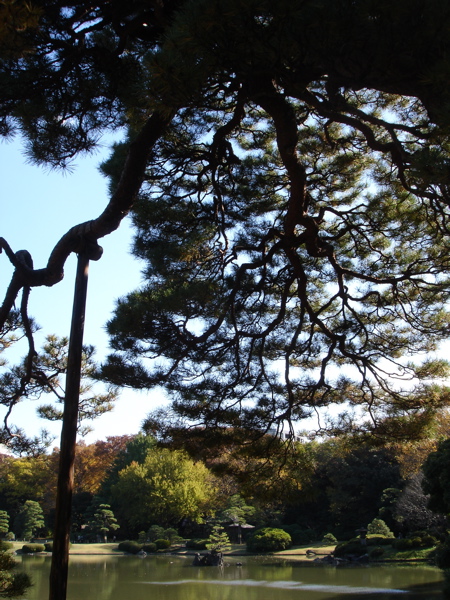
Working on my term paper

I struggled for two weeks to restate the goal of my project, following the  professor's comments. I sort of knew what I wanted, but I didn't know where I was going with it. Finally turned in this statement:

Japanese Gardens are the subject of poetry; poems are created and read in gardens. They appear as backgrounds in scroll paintings, and emaki painters designed many of the earliest gardens. Japanese gardens grew out of reverence for nature, but trees and plantings are shaped to conform to a Japanese ideal of nature, making gardens a true art form. In some, the viewer can appreciate the scene from a special place, a frame, in others the viewer can be more interactive, he or she can enter and stroll along, each few steps presenting a different view, much like walking through a museum and stopping to examine and appreciate each picture.

 Rocks, water, stone lanterns and decorative bridges, sometimes a tea house, and plants are the elements of a Japanese garden. In addition, the two concepts: illusion/shakkei or captured scenery, and replication of famous places, are often used to organize the garden space. I will explore the use of those elements and ideas to create aesthetically pleasing spaces. Then, using maps and photographs I propose to examine Kenroku-en in Kanazawa, Koraku-en in Okayama, and Shirotori in Nagoya and two gardens meant to be viewed from within a building, Chishakuin and  Nanzen-in, to determine what constitutes an aesthetically pleasing space for me.

Now I have to begin writing the paper. I have several free hours after my Osher music class this morning, then lunch, then just missed the bus so walked a mile or so instead of just waiting for the next one. Of course, a cup of tea was necessary as soon as I got home. Listened to phone messages. The Republicans have the wrong number for someone. Opened Word. Did you know National Geographic has jigsaw puzzles you can play with on line? Last night was a reception for a Gigapan exhibit David arranged in the US Steel lobby. If you zoom in on the right side you can see Ivetta's head, my back and Qing, one of my ESL students. Because the camera keeps moving, if the person moves, only part of her will show up.

Only an hour before I have to leave. Guess I better start writing.
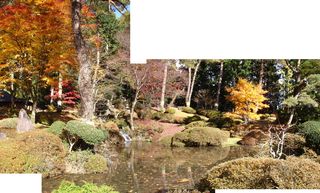
Rearranging my life

I'm staging my own private rebellion this morning. I was supposed to go to the African food class; went back to bed instead. This is the second of this term's classes I've bailed on. My tolerance for nonsense gets shorter and shorter. The problem is finding replacements. I don't want to sit home in front of the computer. I do too much of that already. I'm still turned on by the Japanese art history; still doing the reading. I've decided to write a final paper this semester–about Japanese gardens, of course. Then I can put it in my book.

A one paragraph statement about our final project is due today. Here is my statement:

I walk through a Japanese Garden in much the same way I walk through a museum, each few steps showing me a new view or picture to examine and appreciate. Some gardens give me more pleasure, I return to them over and over. Others don't hold the same enchantment. I look for magic in a garden, just as I look for magic in a work of art. That's the only way I can define it. Most Japanese gardens have the same elements: greenery, water, rocks, stone lanterns; yet they seem to be able to come up with infinite variations. Clearly, some are more successful than others. Some don't begin to be interesting. I propose to examine three or four stroll gardens, considered to be among the most beautiful in Japan, in terms of their use of space (mapping), illusion (shakkei or captured scenery), management of vegetation and growth, replication of famous places.

This is an opportunity to explore why I liked some gardens and not others. I am delighted with the serendipity.


Kentucky 2

This will be a short update with more to come. Tuesday is always a very long day for me–African food in the morning, then Japanese art history all afternoon, and tonight the class went out for dinner together. I'm getting bored with the African food, always seems to be some kind of rice and beans, but the Japanese art history remains my favorite.

Back to Kentucky: I drove out on Thursday. It's an easy six hour drive, but with all my usual stops it takes seven. I had a book on tape–Richard Russo, Bridge of Sighs. I got through the first five CDs on the way out. Coming back took longer–lots of road work. I got into CD12 then finished listening at home. There are 21 CDs and I like the book so much I have to figure out how to finish it. No more driving but that's when I like listening the best.

I stopped at what was purported to be an excellent outlet mall between Columbus and Cincinnati. (Most of the trip is going across Ohio.) Anyway, the stop reinforced my belief that outlet malls aren't worth much. I would like to get another bookcase, something I swore I'd never do. I looked in Pottery Barn but found nothing. Walked over to the Harry and David store. Many years ago a friend sent me a box of amazing pears from Harry and David; the best I've ever had. They didn't have stores then; the store didn't have anything I wanted. Oh well.

Labor day labors

It's been a beautiful weekend, the best one all summer–sunshine, cool breezes. I walked about a mile on Saturday, then two and a half on Sunday. This morning I went back to my health club to work out. Rehab was closed, so you can tell how dedicated I am. Unfortunately, my afib kicked in; I was wiped out all afternoon, never got out to another beautiful day. I feel better this evening after taking a long nap. 

I'm so inspired by the Japanese art class I printed out all the readings and I'm slogging my way through them. Most of it is way over my head. I vaguely remember something about Hegel from college, but never read any Foucault or the other two guys. The class is about space in Asian art. I understand a lot about space in art, but I"m not at all sure about the readings. I'm anxious to get to the class tomorrow, find out if anyone else understands this stuff.

After making several flag books and a few single page books I'm back to work on my garden book. I think I've got about 250 pages already, mostly photos. I'm thinking about another trip to Japan, probably April or May. I don't know how this will work with my afib or all the blood tests, but I've got a little time to work on it.

This week is Rosh Hashanah. I wish you all a happy, healthy, peaceful new year.

Back to school

My new semester started this morning with another cooking class: Food from Africa. We got some information about vegetables grown in Nigeria, then a demonstration of how to prepare and fry plaintains, and finally, a chance to taste the results. I love these classes even though I seldom cook–just enjoy watching someone else do it. And eating the results, of course.

I'm taking another Japanese Art History class that met for the first time this afternoon. This one is called Space and Place in Asian Art. Sitting there, thinking about the use of space in Japanese art, I realized my likes and dislikes of Japanese gardens had to do with the use of space. The gardens I didn't particularly like had huge, broad lawns. The ones I loved made use of densely designed space. I am anxious to see whether I can refine my ideas as the class progresses.

Speaking of cooking, you who know me will be amazed to hear I cooked something tonight. In a weak moment, probably five months ago, I bought a package of frozen swordfish steaks from Trader Joes. You can tell how anxious I was to cook it. Finally, I knew I had to do it, or else throw it out. I browned the fish on both sides on top of the stove (an old electric with burners that slope at various angles). Then five minutes in a 450 oven to finish it. Doused with lots of lemon juice, it was good. Because of the way they were packaged all three pieces had to be cooked at the same time. Now I have one very large piece and one small piece left over. You know some of this will be thrown out. This is why I don't usually cook.

More snow!

We have had more snow in February than in all of Pittsburgh's recorded history. It's not a record I'm enjoying. I stayed home most of yesterday; today I'm going to a film about Japanese kamikaze pilots. It's being shown at a school about 2.5 miles from here. I plan to try walking. I can always get on a bus, but walking would be good. I got two good walks in last week. It all depends on whether the sidewalks have been shoveled.

Pittsburgh has a law about pavements being shoveled within 24 hours.  After the big storm, now four weeks ago, the city suspended the law along with any other intelligent ideas about dealing with the snow. (Sometimes I think the mayor has suspended intelligence.) This time the city said walks have to be shoveled–tomorrow. I'll see how far I can get walking.

Here is another picture I put together yesterday. It's from a garden in Nikko, called Shoyoen, behind the Rinnoji Temple.

Shoyoen-base-1

Beautiful, sunny morning

I got in a good walk. It's supposed to snow again later, and maybe tomorrow. I've been spending a lot of time working on that Gigapan. Sometimes it's extremely frustrating, but then equally satisfying when something works out. Learned lots more about Photoshop. I don't own the latest and greatest, which is what I'm using at the university, but help files for several versions are online. Very satisfying to learn all the new stuff.

Back at home I'm working on the Japanese Garden Book. Decided on format and layout design. For the most part content will be my photos and info from the Internet; layout is very important to me. I've decided to make it 8.5 x 14, with the width being 14". I've completely the pages for the gardens I visited in Tokyo, about 50 pages. I'm very nostalgic about it all and contemplating another trip. Stay tuned!

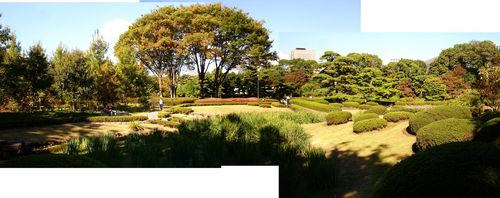
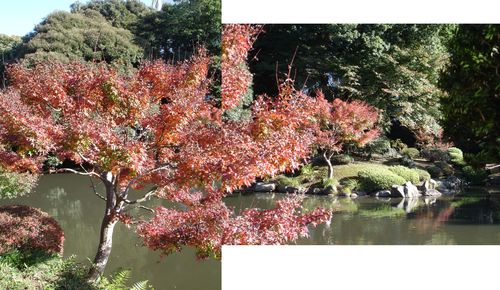
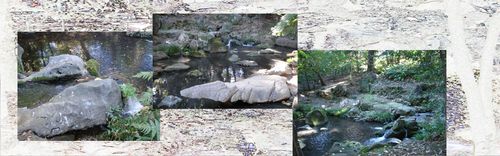
Many of the photos I took never got published, in the blog or in the book. So this is my opportunity to published most more of them. On many occasions I took what I hoped were multiple, overlapping pics. I've been sorting them out and putting them together in Photoshop. 

East-Garden-collage

Kyu-collage3

Tokyo-National-Museum-Garde


New project

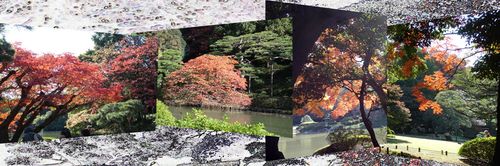
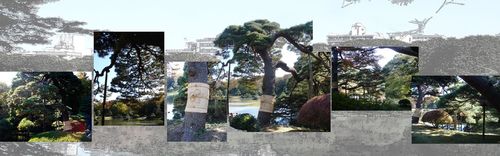
The next book I make will be about Japanese Gardens, at least the ones I've visited. I'm still enchanted with the gardens. I would like to return to Japan and remain from October through April or May so I could see the gardens at the most interesting times. It probably won't happen, but working on another book lets me enjoy the photos and memories all over again. Here are three collages using some of the photos from Rikugien, the Tokyo garden where I met the origami lady. Most of these photos were not posted before.

Rikugien-base-4

Rikugien-base3

Rikugien-collage

I never took multiple Gigapan-like photos as I did in my backyard, so I can't make that kind of collage. Only the one immediately above comes anywhere close to it. I want to immerse you in my view of the garden. I don't think any of these are really successful; I'll keep trying.

New York Tuesday

Very full day. We began with Hockney on 57th St. (He's in two places.) I wanted so much to love his work. I find it intellectually interesting–sort of–but I'm back to the question: what is great art? There was one piece, at Pace prints, I really admired. It was largely computer created and probably impossible to do without a computer program. Inspiring! (Hockney slide show) I like the pictures online better than the real thing.

On our way to the subway to go to Hockney two we passed an amazing gallery called Ana Tzarev. It was huge and filled with the work of Ana Tzarev, a woman I had never heard of. I'm not about to tell you I've heard of every artist, but the size and location of the gallery made me wonder about who bankrolled her. You can read all about her here and here. Amazing what you can do with money.

Hockney on 25th St. was a little more interesting. There was more work, more thinking about perspective, which of two paths to take, stuff like that, but no AH Yes moment, nothing to enter and get lost in.

Back to the subway to one more show, but first lunch. We stopped at Cosi's, a decent fast food place. Along with the ingredients for each dish were the calories. I must say it gave me pause: I selected my lunch very carefully and ate mostly vegetables. I'm not complaining. I was just amazed at how meaningful this was to me.

The last show was Serizawa at the Japan Society. I've known about Serizawa for years. His wonderful calendars were sold at Aiko's in Chicago. But I had no idea how prolific he was and how wonderful his work is.

Hockney

My motivation for this trip to NYC is to see the Hockney show at PaceWildenstein. I first became interested in Hockney when I discovered his photo collages. I had little interest in his early paintings, particularly the swimming pools, but have enjoyed reading his thinking about painting and photography.

Some of his photographs bear some similarity to the Gigapans I was playing with. In a lecture he gave in 1983, he talks about photographs being an instant in time, whereas paintings are a record of time passing. 

Why is a painting based on the camera (and with one viewpoint) more interesting than a photograph taken from the same spot and enlarged – even when taken with a large plate camera? And my conclusion was this lack of time, the static quality photographs have is due to the fact that it's the same time in every area of the picture. The removal of the hand (the removal of the body) causes this. The hand moving through time reflects the eye moving through time (and life moving through time). The evidence of the hand is our time. On Photography, © David Hockney, 1983

I would love to know what he thinks of the Gigapan, which is after all, a robotic hand moving through time.

He also compares the use of one point perspective in Western art to the multiple viewpoints in Cubism and the progression of images in Chinese and Japanese art. 

The Hockney website

More about Hockney

http://www.youtube.com/v/cIfDdW9GKmA&hl=en_US&fs=1&rel=0

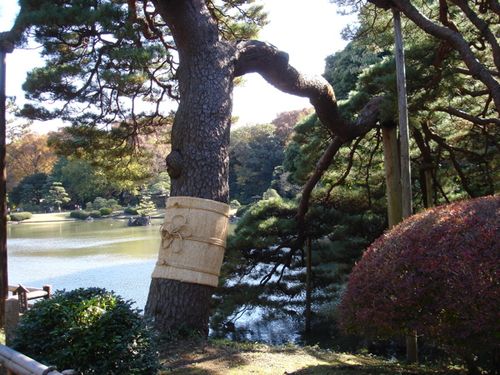
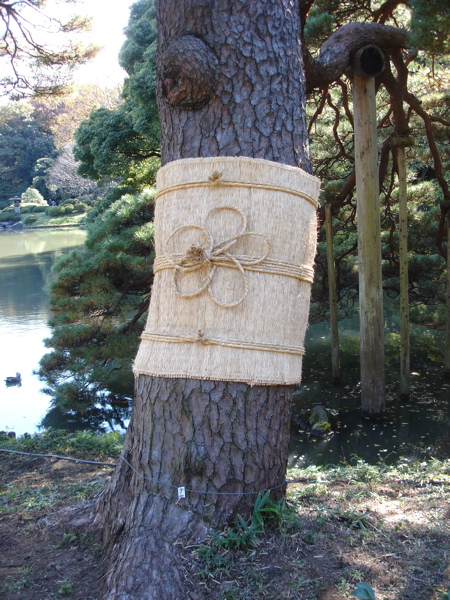
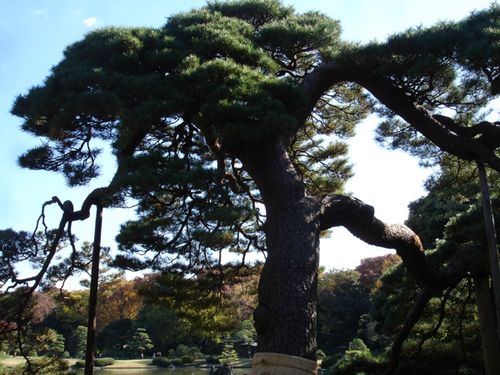
So what, you may ask, does all this have to do with the exhibit of his paintings in New York? Thinking about Hockney I came up with his photo collages, which are making me think about my own work. I would like to do a book about the Japanese gardens I visited. I would like a way to present more of the photos I took–I never posted all of them. Just as I did with the collage I made of the photos of the 300 year old pine tree in Tokyo, I often took multiple shots of views that didn't fit into one image. How do I present them in book form?

Here are some of the images I'm playing with:

Rikugien - 26

Rikugien - 20

Rikugien - 25

Rikugien - 24

Rikugien - 19