Women Culture Museum: how could I forget

I am almost finished compiling my China book. As I neared the end I realized I had entirely forgotten to write about the Women Culture Museum at Shaanxi Normal University. It made a very big impression on me while I was there, but somehow totally disappeared from my head while I was writing the blog. So much for short-term memory.

I think we went on October 28, the only day I have no account of activities in the afternoon. This was another CCS expedition: Eva took us with Mr. Wang driving. I think Andrea, Natasha and I were the only ones to go. Laura may have been working, or she was sick. Shaanxi Normal University, Chang an campus, was a large, new facility about a half hour from the apartment. I don't think the museum was a tourist spot open to the public; a visit requires special arrangements to be made.

The first gallery, titled Her Story, "displays the women's struggles in Abolishment of Binding Feet, Revolutionary War, Anti-Japanese War, Cultural Revolution and so forth in the 20th century. In the part, we have a special exhibit "An Ordinary Woman's Story". The intention of doing so is to praise the life value of ordinary people." I am quoting from the brochure we got at the museum. I found the exhibits about foot binding to be incredible and horrifying; the rest of that gallery not so interesting.

Since my recollection of the museum is now dim, to say the least, I will continue quoting from the brochure. Also the website I linked to above has some good information about each of the exhibits. The second gallery was called "Women's Characters in Hangyung. Around Hangyung County, Hunan Province of China, there is a kind of peculiar character, which records the local dialect. It is only used and imparted among the women, and it is a uniqlue (sic) in character history of the world. We call it "Women's Characters". In the Museum, there is a big collection of relics about Women's Characters such as "Fan scripts", "Handkerchief scripts", and "Wedding Congratulation letters". In addition, exhibited here are the tools used by women when writing everyday life articles, pictures and some written materials by the successors of Women's Characters."

Sometimes Chinese "English" requires almost as much interpretation as translating from Chinese characters. What they are really saying is that a community of women from this county in Hunan created their own written language, which was never shown to men. They used it only for women things. Use of these characters is now dying off; only a few women who know it remain alive. The museum is trying to preserve this heritage.

The third gallery is about sex. "Reproductive culture is long neglected by the main culture. Exhibited here are some symbolic genital worships and art works as well as indigenous child-delivery tools and aborticide."

The fourth gallery displays women's craftwork. "The world of Women Craftwork is abundant and beautiful. In this part, there is a big collection of women craftworks, such as weave goods, knit goods, embroideries and decoupage." Not mentioned in the brochure, but hugely impressive, are the papercuts of Ku Shulan, who called herself the papercut goddess. You can see some of them here and here and more about Chinese paper cut art here. This was my favorite gallery, although I found all of them interesting.

The last gallery was a large hall displaying wedding dresses. "This part mainly exhibits bride's wedding dresses. When the girls had learned how to do needlework, they began to prepare their wedding clothes. While making the wedding clothes, they were filled with happy thoughts about the future. Any nation's marriage customs has its own tradition. The style, the color and the pattern of the wedding clothes maintain a stable content, a nation's oldest worship and its symbol. The museum has collected about over 50 kinds of Chinese wedding dresses."

Most of these dresses were collected from the ethnic minorities living in China. They were diverse and beautiful. I don't know how I managed to erase all of this from my memory.
Some things are never clear

I went to my pacemaker doctor (cardiologist) for a checkup, on Friday. I think he was worried because I was out of the country for such a long time. Everything checked out fine. Under his questioning I finally confessed that I had had a couple of incidents when my heart was beating too fast (one of the symptoms that won me the pacemaker), and another occasion when I felt funny, like maybe short of breath, but I didn't really know what short of breath meant. We had quite a long discussion about all of this, the question being, when should I call him, or when should I go to the hospital. He told me that the fast heart rate wasn't important if it didn't last too long. What is too long? I was thinking three days. He said ten minutes, thirty minutes and I should get to the hospital. He urged me to call and come into the office if I have another "shortness of breath" incident. I guess that makes the whole thing somewhat clearer, but the truth is I still don't understand what constitutes an emergency. Obviously none of these incidents qualifies; it's been many days and he thought I was just fine.

Famen Si: What is it?

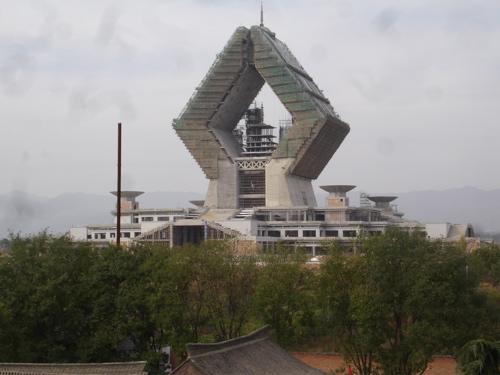
As I work on my China book some of the questions surface that I never got answered. This amazing structure, surely something from outer space, was visible as we drove to Famen Temple, outside of Xian. I should have asked our Chinese staff, but I had so many questions I forgot this one. Can anyone give me an answer?

DSC09162

Japan revisited

Even though I am deeply immersed in China while I work on the book, I made a slight detour back to Japan this morning. Studio 360 on NPR broadcast an interview with the travel writer Pico Iyer. I was aware that they were in Japan while I was there and I have been waiting to hear about their visit. Pico Iyer has been living in Japan for the last twenty years. I think his description of Japanese culture and society and of his status on the fringes largely sums up my feelings about Japan. You can listen to the interview here.

http://www.studio360.org/flashplayer/mp3player.swf?config=http://www.studio360.org/flashplayer/config_share.xml&file=http://www.studio360.org/stream/xspf/122032

The video and a slide show can be found here.

Book details

We have had quite a bit of snow (and rain) the last few days and I've taken the opportunity to mostly stay in and work on the China book. I now have 85 pages going through October 26, including pictures, emails and chats if they were not about my firewall troubles. I've started another file with information about the places I visited that I've copied straight off the internet. There are about 12 pages in that file. This book could have 250 pages. I have even more pictures from Japan. I don't want to think about that yet. I'm using Adobe InDesign to lay out the book and Photoshop to resize the photos. While I was in China I used Picasa on my toy computer, which had a Linux operating system. Now they are on my Mac and I am using iPhoto to manage them.

I have also started to think about the cover. I never found any fabrics in China and I really regret that, although I have some things I bought in 1982 when i visited the first time. I'm just not sure I want to cut them up. I bought two obis and a beautiful old kimono in Japan. I suppose it won't matter if I use some of that fabric. Or, I may have something else stashed away.

Congratulations to my friends in Chicago on your new governor. How did Blago ever get elected twice anyhow? I remember him from when I was still living in Chicago. I suppose I would have voted Socialist Labor again. I kinda remember the choices weren't great.

More healthcare

Ronni Bennett at Time Goes By has posted a wonderful article about healthcare. This one, written by AQ, a retired Navy Corpsman and a Red Cross Disaster Services Volunteer who blogs at Always Question, details how costs are figured by the insurance companies for payment by Medicare and, of course, by us. If you are interested in the thorny questions about healthcare, be sure to look at this post along with the New Yorker article I linked to yesterday. One other consideration no one seems to mention: what happens to the economy when we add those insurance company employees and the paper pushers in doctor's offices to the unemployment statistics.

Revisiting the week

This afternoon I went to the fifth lecture in five days. Each one was different, not only in content, but even more in presentation. As a former Toastmaster I found this fascinating. The first lecture, on healthcare, used Powerpoint as a guide for herself, to make sure she covered all of her points. She went so quickly on some of them I didn't have time to finish reading.

BTW, the New Yorker has an excellent article about healthcare by Atul Gawande in the current issue. Even though I have been working for a single payer system his argument makes tremendous sense to me. 

The second lecture, on government regulation, used no visual aids but gave us several handouts: one of her columns; a memo from Rahm Emanuel about regulation sent out on January 20; a diagram of the regulatory process; and information about her book, The Regulators, all interesting and useful.

The third lecture, about our foreign policy, used some very old, stained and faded overhead projector slides, along with bad jokes and lots of sarcasm. A professor who has won several teaching awards probably felt the need to entertain us. Do you get that I hated him, jokes and all?

Friday afternoon, the fourth lecture was given by a retired general. He was wonderfully organized, very pleasant and gave a good lecture about stuff I never thought about. Can't ask for more than that.

These lectures were all part of the Osher program at Pitt. Today I went to a presentation at CMU (Carnegie Mellon), the other big one here. This was about Arthur Szyk, (pronounced shick) an almost forgotten artist who lived from 1894 to 1951, and who created amazing illustrations of books from the bible and equally amazing illustrations responding to events of World War 2. There is an excellent website about him here and more illustrations of his work here.

This lecture was held at the Tepper Business School at CMU in a room with a monitor in front of each very comfortable chair. The illustrations appeared on each of the monitors as well as a large screen at the front of the room. It was a wonderful luxury to be able to look closely at each of the pictures. 

Most people have never heard of Szyk, or never heard his name pronounced so didn't realize who he was. I was always looking for beautiful books, even as a child, and remember seeing his Andersen's Fairy Tales and Rubiyat of Omar Khayyam, as well as his Hagaddah. I wish I owned copies of them.

Back to the books

My Osher program began this week with two lectures on Wednesday, one yesterday, which I left a few minutes early to go to my Japanese art history class, (I'm still at it), and there will be another one this afternoon. All of the lectures are about various aspects of our current political and economic situation. They are given by guest experts or experts from the University of Pittsburgh. The first lecture, given by a distinguished professor, was about health care and the Obama administration. In the afternoon the lecture was given by a guest, Cindy Skrzycki, who writes on regulation and the executive branch of the government for Bloomberg, formerly for the Washington Post. Yesterday morning another distinguished professor spoke on foreign policy issues. This afternoon a guest expert will speak on military issues.

I learned a lot from the lecture about regulation, the one in which I thought I had the least interest. She explained how regulation affects all of our lives (and it does); how regulations are promulgated; how they are created or changed by lobbyists and special interest groups; how we can, and should, become aware of pending regulations and voice our concerns. For your information, read more from Cindy Skrzycki here (scroll down), find info about new regulations and how to comment here.

The other two speakers were good, but offered rather bleak views of their topics. Both reviewed the existing situation and what Obama has said and done up to now. After reviewing the healthcare situation in a very pessimistic manner, the speaker, almost in passing, said she was for a single payer system, but didn't think it would ever happen. She is one of many health care professionals I've met who seem to share this same point of view. I hope they are wrong.

January 20

I spent most of the day watching television; more than I've watched in many years. I can listen to this President in a way I haven't been able to do for many years. This time I wanted to witness everything myself, not just hear about it later.

This was also Charna's eighteenth birthday, a great day for a wonderful young woman who supported and worked for Barack Obama, who works for ending the genocide in Darfur, who is committed to environmental causes and who embodies all of the qualities, the hard work, responsibility, creativity and "smarts" President Obama believes we have. Happy Birthday, Charna.
Library - 10329

I skipped my class yesterday; today the Osher program begins with two lectures about current affairs. I will brave the cold and get out of here.

If I was thirty years younger

I probably would have been there, freezing on the Mall, texting messages to my family back home. One of the virtues of age is that I no longer have this burning desire to be a participant; I am content to remain at home and watch on the television. I have done my share: I marched against the Vietnam war, over and over again. Amongst many other things, in 1968 I was in Washington to visit "Resurrection City," the demonstration encampment against poverty and in support of civil rights. Today I will stay home and watch and send my good wishes and hopes to the new President.