Celebration

I passed my stress test–even impressed the doctor with how well I did. This kind of nuclear stress test–they inject you with something radioactive then measure how much accumulates in your heart while you are on the treadmill–evidently is able to show whether you have any blockages. They assured me I was fine and should be able to do whatever I wanted, including going to China and Japan as I had planned. This is the happiest day I've had since I had the problem in New York a month ago. It's been a hard month, psychologically, especially after Tim Russert's sudden death. My pacemaker required some adjustment, which is probably why I haven't been feeling so wonderful all this month. Pacemakers are supposed to make you feel good.

I've been continuing with my exercise program–leg exercises, walking, and finally got back to the health club yesterday. I haven't been able to do my usual 3 miles, only 2 miles each time this month. I'll try again the next cool morning we get here.

Last week I wrote about a wonderful painted house we looked at on Pittsburgh's North Side. You can read about it and see pictures here.

Where I live

One of the classes I am taking is called "Reading and Writing the Iron City." Following is the story I wrote for my first assignment.

Meade Place is special—this was the clear message I was getting from Earl, as he showed me the apartment. He told me about the quiet street: the neighbors, Mary the quilter across the street; Sari the artist next door. He made me feel I could belong here. I liked the apartment; it reminded me of my house in Chicago; the only place I left with tears and regret.

Earl didn’t tell me that Meade Place had a special history. Shortly after I moved in Mary came to welcome me and brought a packet of information about the neighborhood. It seems that Meade Place was once the driveway leading to the mansion of H. J. Heinz. A 1999 article from the Pittsburgh Post Gazette described the mansion, how it was built; the additions Heinz made to it; and the many things he collected. The mansion was torn down in the 1920’s; the land subdivided for small homes. Only the coach house and a small building that once housed H. J.’s collections remain, now reinvented as apartment buildings, along with a low stone wall and a decorative cast iron fence along Penn Avenue, the south boundary of the property.

The area is very much a middle class enclave clinging tightly to its civility on the edge of chaos. We prefer to think of it as North Point Breeze, although it’s hard to say where it ends and Homewood, once the home of Pittsburgh industrialists, Westinghouse, Carnegie and Frick, begins. On summer nights we occasionally hear shooting from Homewood. The Westinghouse property, about a block away, is now a huge, open field called Westinghouse Park, where I am not entirely comfortable walking.

Most of the homes are single family. The owners are largely professional: a librarian, a doctor, a social worker, a newspaper editor. The building I live in, and the one to the east are almost identical duplexes. Earl lived upstairs in my building until several months before I moved in. The other duplex, not owner occupied, was converted into three apartments, and was the source of considerable tension in the neighborhood when I first arrived. An unknown number of tenants lived on the first floor. They were noisy, left beer cans on other people’s lawns, left a car on the street for months with one wheel removed. Since they left the street has once again become a model of middle class serenity, at least on the surface. Two women live in the attic of the duplex. We say hello, but not much else. After Christmas, Mary found their picture in the PG, in an article about Christmas dinners supplied by the Salvation Army for people down on their luck. The article said our neighbors lived in Homewood. It all depends on your point of view.

Literary week

New Osher classes began this week. I’m taking one called Reading and Writing the Iron City. We did a fun exercise in class that may inspire me to do more writing. The instructor created a blog for the class, which you can visit here. BTW, the 250 in the blog name refers to this being the 250th anniversary of Pittsburgh’s founding as a city.

On Monday night, Robin and I went to a lecture by Scott Simon, the NPR Saturday morning anchor, who has written a novel about the Chicago city council. He said some of the reviews have called this satire, but he calls it political comedy; he says satire requires exaggeration. I loved the talk. He loves Chicago and so do I; very nostalgic. And, of course, I have to read the book. (After I finish writing my paper for the Japanese art class and read at least two other books: Hiroshima in America by Robert Jay Lifton and Gregg Mitchell, and David Halberstam’s last book, The Coldest Winter.  My paper deals with Hiroshima, but the books are not reference material.)

Last night, Robin and I went to another talk, this time by Dave Eggers, of McSweeney’s, also with a book: What is the What, about Valentino, a Sudanese refugee. Although Eggers talked about the book and his visit to Sudan, most of his time was spent on the project dear to his heart, 826 Valencia, a writing center for children 6-18, now with spin-offs in seven cities around the country.

Have to stop now; it’s time to go to tai chi.

Falcons and Skunk Cabbage

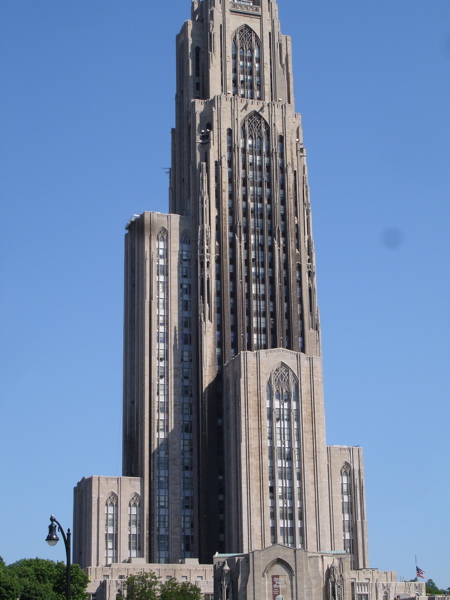
This week is spring break, but I’ve had wonderful OLLI provided experiences, all having to do with that additional level of awareness Alice mentions in her comment to the last post. After the geology walk on Wednesday, there was a class about the peregrine falcons that call Pittsburgh home. There are nesting boxes on the Gulf Tower downtown and the Cathedral of Learning at the University of Pittsburgh,Cathedral_before_cleaning_was_fin_2
both evidently look like cliffs to the falcons. You can see a webcam and learn about the Gulf Tower pair here. There is one egg in the nest already. That website from Pittsburgh’s National Aviary has links to the Cathedral of Learning webcam and to a bird blog written by Kate St. John, who was one of the presenters at our class. Our other presenter was Dr. Tony Bledsoe of the Biological Sciences Dept. at Pitt, who did a great job giving us all the facts about falcons.

Yesterday we went on a bus trip to the Powdermill Nature Reserve, the biological research station of Carnegie Museum of Natural History. You have to understand: I am very much a city person. I haven’t had a lot of contact with "nature," and I approach each event with a mixture of curiosity, awe and fear. I wasn’t sure what I was going to see at this time of year, possibly more mud, but I figured I had nothing to lose.

We spent the morning learning about the sustainable facilities development project and the Marsh Machine, their waste water treatment greenhouse. Powdermill Run is one of only a few streams in Pennsylvania considered excellent quality, never having been polluted by mine drainage. Here is an excellent article from the Post Gazette about the new facility, which, incidentally, uses carpeting made from recycled plastic bottles, counter tops made from compressed paper, flooring tiles from recycled tires.

After lunch, we took advantage of the beautiful spring day and walked on some of the trails at the reserve. I got my first good look at skunk cabbage,

Dsc06784

loved the little ferns just beginning to grow,

Dsc06793

and marveled at the rushing stream filled now with rainwater and melted snow. (Our guide, Theresa, is speaking with one of the members of our group.

Dsc06801

My friends in Chicago used to tease me–I was never lost in the city, but take me out where there are no street signs and I’m immediately lost. I need a lot of help learning to see in the natural environment.


Very satisfying day

This is Spring Break, but my geology class met today for a geology walk in Frick Park. It was a little gray and cold, and a lot muddy, but a great experience. This is the park I walk through fairly often. Today was completely different. I always look at the trees, the birds, the flowers. I’ve noticed the rocks, but never given them much thought. So, it was almost magical when Al Kollar, Dsc06757
from the Carnegie Museum of Natural History, showed us the evidence of how this area was under water, at least twice, and how the sandstone eroded to create the hollows and ravines in the park.

I was amazed to learn that the stones in the path were formed somewhere else two million years ago and deposited by the water. Dsc06762
Huge boulders I had walked past many times had fossils from sea water creatures. Still hard to see, but who knew! Alongside the path there was a fast moving stream–never there in summer or fall. It was almost like I was in a different park. Here’s an island beginning to form from the sediment in the stream.Dsc06759

There was lots of mud. Dsc06772
You can see all the traffic: bikes, dogs and people. The red mud is from the Pittsburgh red beds. Everything has a name.


Here are my muddy shoes. I haven’t had so much mud on my shoes since I was a kid.

Dsc06771


Wonder of the Internet

Back in December I wrote a post about a church whose deterioration I’ve been watching from my fitness club parking lot, and asked if anyone had any information about it. Alice, from Wintersong, who currently lives in Salt Lake City, but once lived in Pittsburgh, replied that she would ask a Pittsburgh friend about the church.

Shortly thereafter I received a comment from M L Greene with some information about the church. Two days ago, Mage from San Diego, who posts at Day Tripper, sent me a link to some beautiful photos about the church. Although never identified in these photos, and I never before noticed the large red chimney/incinerator next to it, I couldn’t believe there were two different places with the same damage to their spires.

I drove over to it yesterday. It is the same church. The red chimney (or whatever) is behind it. The windows are boarded up, the damage to the spires continues, but the chain link fence is gone and there is a sign inviting people to come for "The Word" on Sundays at noon. So the church has become useful again, and hopefully will be repaired. Some Sunday at noon I’ll go over and see it.

Amazing, isn’t it, that people from all over the country can join together to give information.

A matter of perception

SteepleI see this steeple each time I go to the health club to exercise. I
drove past the church once. It’s locked behind a chain link fence with
no indication of what it might have been. I don’t know
anything about it; what happened to it; whether anyone owns it. I took  this picture in October, 2006.

Dsc02104
This one was taken in April, 2007.
I am troubled by the continuing deterioration. I keep wondering how it will look when one of these towers finally falls.

Last week I had lunch with Linda and two of her poet friends, both of whom are long-time Pittsburgh residents. They began to talk about churches and I asked them about this one. Neither knew anything about it, but when I said the steeples had holes in them one of the women said she thought they were patches. I keep thinking about the difference in our perceptions. I’ve been accused of being a pessimist, although I think of myself as a realist. Do you think that’s why I immediately identified those black spots as holes? And I’m not sure what this says about the other woman.

I’m very curious about this church. It’s in East Liberty; you can see it from the Club One parking lot. If any of my Pittsburgh readers knows what happened to it, I’d love to hear from you.
I took this picture today.

Dsc06565

Weekend update

Yesterday I was playing tourist in New York again. I met a friend at the New York Historical Society where we saw a wonderful exhibit about the Marquis de Lafayette’s return to America in 1824 when he was 67 years old. He visited the 24 extant states traveling by road, in very uncomfortable looking carriages, and by water, and taking about 13 months. I decided I would like to retrace his journey. Any excuse to travel, right?

That was my first visit to the Society. I was impressed with their collections and the way they are showing them. They also have extensive documentation online of those collections that include many Tiffany lamps and Audubon prints.

I couldn’t walk around New York without going to the Met. We saw an impressive exhibit of tapestries, some of them 500 years old and still in great condition. They have set up a new gallery for contemporary photography. I always wonder how they select the artists; I certainly would have done it differently. Before I left the museum I spent a lot of time looking at books in the store. I didn’t want to carry them around with me, but there are a number of them, especially on Japanese Gardening, that I would like to own.

My blog about my trip to Japan has been written up today in the Pittsburgh Post-Gazette, in a great article by David Bear, Travel Editor. You can see it here. I was particularly pleased with the excerpt he chose to quote from the blog. I guess this is my 15 minutes of fame.
 

Six or Seven Miles Today

I made up for my lack of exercise yesterday. This
morning as I prepared to walk with Phyllis I foolishly decided to leave
my camera at home. I almost always have it with me; it’s no bother to
carry it. But Monday when we walked there didn’t seem to be anything
interesting. I thought today would be the same. As soon as I went
around the corner I knew I had made a mistake. Then, all during the
walk we found wonderful images. I guess the light was better this
morning. It was very warm and much brighter. The sun actually appeared
this afternoon.

I decided to go back again; it wouldn’t look the same
next week when I got back from New York. First I had to do another
errand, then lunch. I had already walked about four miles; another
three wouldn’t hurt.

I began by walking around the corner to photograph this vine growing on a post.

Dsc06475_3

I think it was better in the morning; probably had
more leaves. Then I got into the car and drove to Frick Park, not my
usual practice, but I didn’t want to be totally wiped out
.


This is the beginning of my walk.

Dsc06479_2

Most of the trees are bare, but a few really stand out.

Dsc06513_2

Some things show up much better when there aren’t so many leaves.

Dsc06484

Then again, some things are better hidden.
This massive house is barely noticeable in summer; now it looms
monstrously. One could wish for better zoning laws or enforcement.

Dsc06491_2

This
morning I noticed a branch with some wonderful, delicate fungi. I
continued walking almost to the end of the trail to find it.

Dsc06508_2

I found this log with a beautiful growth on it. I wish I knew more about these things. 

Dsc06519_2

Here is one last tree to show you. I suspect it is the
last beautiful tree of this autumn. I wish I could make a portrait of
every tree.

Dsc06526_2