May 13, Last day in Kyoto, last night with family

Steve and Charna went on a long bike ride over much of Kyoto. Robin and I went shopping, together and separately. She’s a great shopper; I am not. I decided I wanted a cane. Robin has been helping me climb stairs and navigate other tricky walkways and I am having more difficulty this trip than in 2013. It seems like a long time ago and I was certainly in better shape.

We all met up for dinner in another Okonomiyake restaurant in Pontocho, which seems to be filled with restaurants.

Afterward, to my surprise, we went for ice cream to celebrate my birthday. Actually, I’ve considered this entire trip a birthday celebration. When I reached 80 I decided I would celebrate every birthday; generally with a party. This has been an amazing celebration and I will celebrate again in 2 weeks when my actual birthday arrives.

These were some of the parfaits that were offered. Mine was chocolate and more restrained.

We had a fun conversation with a Japanese man who had been all around the world and now worked as a tour guide in Kyoto. And I would have had none of this had I been alone.

May 11, Temples and shopping

I have been to most of the temples, shrines and gardens in Kyoto. While the family went to Fushimi Inari, which entails a lot of climbing, I went to Kamiji Kakimoto, an elegant paper store where I had made an amazing purchase on a previous trip. I bought a small roll of paper, not too expensive and easy to carry home. Only recently I began to use it for bookbinding and decided I needed more of this amazing stuff. Before I left Pittsburgh Karen Gerhart told me it was a special Kyoto paper. It is indeed special, strong and light; great for tabbing sheets together. I will be going to paper stores in Tokyo as part of the workshop I’m taking, so I only bought one other paper roll and an interesting manuscript book, intended for calligraphy but I think I will find another use for it.

I had a long walk from the subway to the store and passed antique shops, furniture shops and some other craft places. After making my purchase I had lunch in a non-fast-food place, no English, not even the prices, and I chose my lunch from the models outside the door. It had a large piece of shrimp tempura, two tempura string beans and lots of rice with possibly egg, cheese and something else. It was good, but remains a mystery.

Met the family at Konchi in Garden, a sub temple of Nanzenji. They had a great time climbing at Fushimi Inari. Charna and Robin bought fox masks, the fox being the guiding spirit for Inari shrines.

This slideshow requires JavaScript.

We went into the Nanzenji grounds, looked at some of the buildings and did lots of people watching. Finally took a taxi back toward Nishiki Market, walked around looking at shops, found the canal at Pontocho, then headed for Sou Sou, where Robin wanted to do more shopping.

This slideshow requires JavaScript.

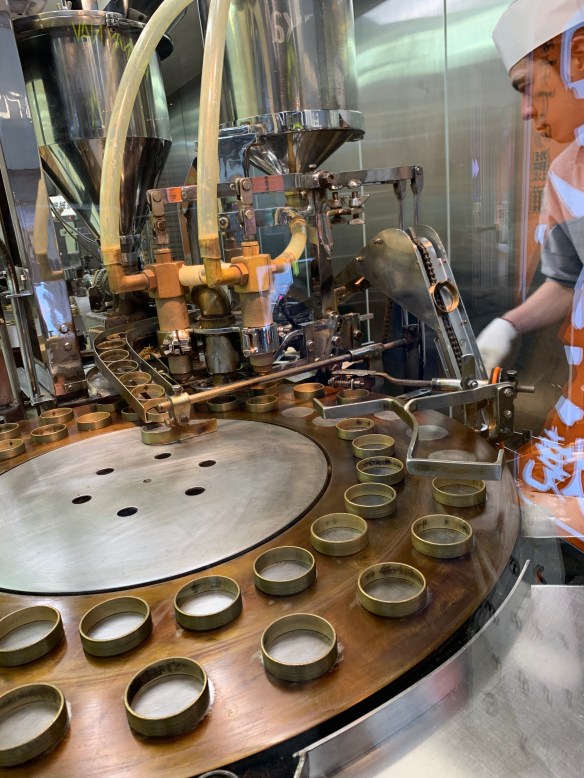
On the way we came upon this wonderful Rube Goldberg machine for making bean paste cakes. I wanted to stay there all night.

9D3ADF8C-6E06-4229-8CA9-C86240C71D50

Last day in Tokyo, May 7

And first day after Golden Week, so everything back to normal. We all felt the need to do laundry. Our little house has a washing machine but no dryer. The nearby laundromat had wood paneled walls and all the machines we needed. It took all four of us to figure out how to do it, but mission accomplished, we went for a walk along a nearby canal and found a tiny almost hidden shrine.

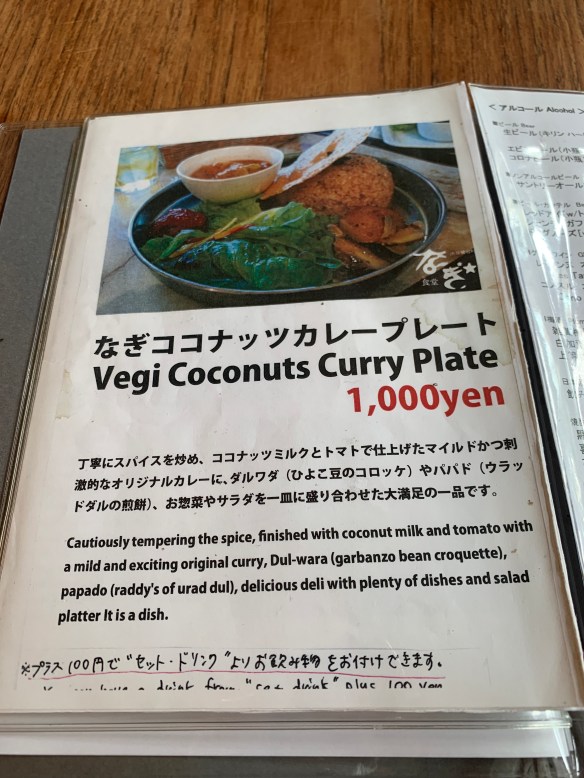
Laundry finished we went to a wonderful vegan restaurant, Nagi Shokuda, for lunch

5BCB7210-84FD-47B6-90FC-BFAB6B9F8016

Where everything was delicious. Then onward to shop. Charna went off on her own; Robin and I went to the Asics store and Steve went to Meiji shrine where he did not shop.

Robin has a terrible time finding shoes to fit and usually has to order online. Today she had the pleasure of actually trying on several different shoes in the store and buying two pairs. I think she would have bought three but began to worry about getting them home. She and Charna are both able to find clothes that fit here. I don’t usually bother looking.

This slideshow requires JavaScript.

We walked in Harajuku for a while then met up with Steve and Charna at a Starbucks on the sixth floor of Tokyu Plaza where I took most of the pictures above. As you enter the Plaza there is a mosaic of mirrors to look at as you rise three floors on escalators. Coming out of the elevator, which you have to take from the fourth floor, you feel like you are in a garden, or they call it a forest. And the Starbucks adds to the charm.

Steve and I headed back and had the Tokyo rush hour experience on three trains leading us to more fully appreciate our first days here being Golden Week. We bought sushi at the train station and all of us had dinner in our little house.

Monday, May 6

Charna went off on her own while Robin, Steve and I went to Shinjuku Gyoen National Park, a huge green space in the midst of a densely populated area, an oasis of quiet with a formal garden, a landscape garden and a Japanese garden.

This slideshow requires JavaScript.

From there we went looking for a vegetarian restaurant. While I planned the trip overall, Robin has researched veggie restaurants. Not easy to find here. This one was on the seventh floor of Isetan Department Store. Robin had trouble believing this would be good, but I was hungry and tired of walking and persuaded her to try. We were seated in a lovely outdoor garden and the food was great. I had a salad with locally grown vegetables. Tokyo has an urban farms movement. We finished at Isetan by touring the basement food section where I got a real baguette. When I was here previously I frequently found myself looking for decent bread. The Japanese prefer something that resembles Wonder Bread but is even spongier. On previous trips I was able to get real bread in some French bakeries. This trip I’ve found fewer bakeries with more items that look good but definitely have the preferred spongy texture.

Finally, totally wiped out, I returned to our little house leaving R & S to explore on their own.

Saturday May 4

Robin went to run a race taking Steve with her. Charna and I went to Meiji Jingu Shrine, shopping in Shibuya and lots of train riding and getting lost in train stations. I don’t know what I will do without her.

This shrine has lots of visitors but also large areas of stillness and beauty. There are beautiful Torii gates and wonderful old trees. We hung out (our specialty) and watched a wedding procession with the public lining the route and taking pictures like this was a Hollywood production. Near the shrine exit there was a marching band accompanying a small procession with someone in a character costume. Needless to say we have no idea what was going on. Just as we were finally leaving we came upon two dogs in costume being pushed in a stroller. The couple, who spoke English, told us the dogs were dressed for tomorrow’s child’s day holiday. These were their children.

This slideshow requires JavaScript.

We had a snack in a Taiwanese restaurant, got lost in a huge crowd in Harajuku and went shopping in Shibuya. She bought clothes, I went to a department store food shop. Now we are back in our little house hanging out and waiting for Steve and Robin.

Finally: Book #87

My father’s memoir, published previously in PDF format and available under Family Stories is now a 200 page bound book. I’ve been working on it, with some detours, since January. First I decided to make this book a codex, that is, a normal bound book. Sounds simple and it could be if you know how many pages the book will have. A codex has signatures, sheets of paper folded in half and sewn together. Depending on paper thickness and how you fold your signature you might have from four to ten sheets of paper. (Commercially published books can have different specifications.)

Signatures

I have ten signatures in the book. Each one has five sheets folded in half to create twenty pages. Now all I had to do was properly arrange the text, which I took from the PDF. Not so simple. In the PDF one page simply follows another. With signatures page 1 will be on the left of one sheet of paper, page 2 will be on right of the next sheet that will become the other side of page 1. Page 3 will be on the left of the next sheet, page 4 on the right. There will be 10 sheets to print front and back creating 20 pages. Page 21 will begin on the next signature. To complicate things a bit more, I wanted to use the inside fold of each signature (page 10-11) to display large drawings or photographs.

Here are the front and back covers of the book. Although my father was trained as a draftsman and did wonderful drawings, he made a living selling chickens to restaurants.


I never photographed my father driving the truck. In these pictures my husband who ran the business briefly after my father had a heart attack is driving.

The PDF I created originally had 114 pages. I knew I would have more pages, if for no other reason than the book is smaller, but I didn’t know exactly where I would end. To make it more complicated, if I was using a five sheet signature, I would have to end on a multiple of 20. That’s a big part of why it took so long. And at least one month was occupied with fixing mistakes. I added as many of his drawings as I could find and many old family photographs. Here is a slide show of some of the pages.


This slideshow requires JavaScript.

I laid out the book using Adobe InDesign. It is printed on an Epson printer with Epson Presentation Matte, 8.5 x 14 inches and folded to 8.5 x 7. Finished volume is slightly larger. Cover is printed on Super Max text covering book board and bound with commercial book cloth.

How does a book happen

Or, how did my latest book get to the light of day. It took a long time.

Most of my books begin with a theme, an idea or an image. Then I look for a structure that fits the content, and finally design the book, deciding how the book is folded or sewn together and the paper, board, physical structure, the typefaces, the look and feel. Often I spend weeks or months with an idea and finally bring it to fruition. For many years I have toyed with the idea of making a popup book. I’ve taken three workshops and spent hours looking at popup books. Slowly I am trying to put it together with some feminist ideas that constantly float in my head. I haven’t gotten there, but I am slowly approaching.

The book described in the previous post began with a trip to Washington DC where I saw work from Burning Man at the Renwick Gallery. 

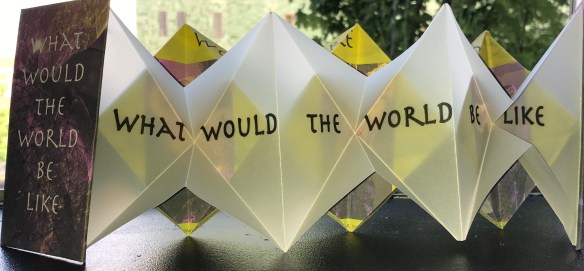
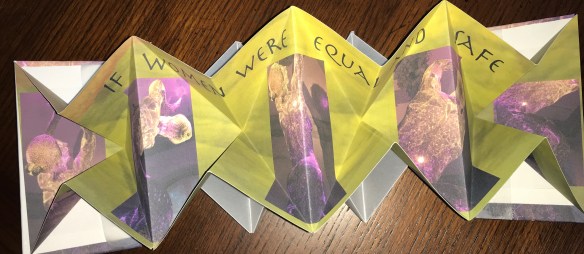
So this is a fold book, kind of a pop-up book. It is made of two folded papers nested together between hard covers. One sheet has the same images on both sides, the other, a piece of vellum, has only the question: What Would the World be Like. When you pull the covers apart the pages pop open in a kind of explosion, as Debbie termed it.

On a second trip to DC I returned to the Renwick and made more photos of the sculpture. 

This time the message would call attention to the power of man’s gaze at women. The sculptor is a man, and this is his interpretation of a safe woman. But women will never be safe until they are equal and will never be free of a man’s gaze until they can equally return that gaze. 

Although I like the images better from this second trip my continued dissatisfaction resulted in another search for an interesting structure. Debbie posted a picture from Instagram that intrigued me until I made a mockup and found it didn’t work.

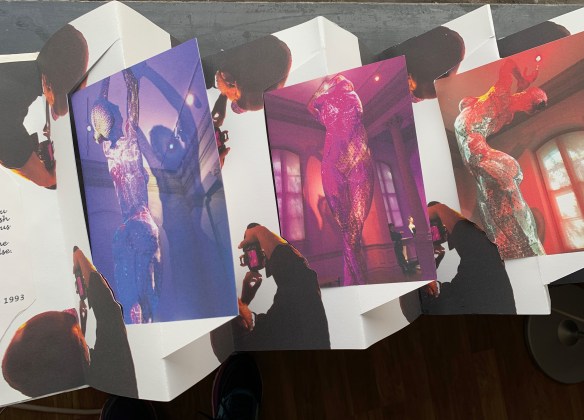
After much pondering and my usual overthinking I went back to the structure I used for the heads in Scotland and the House music book. This accordion structure allows the book to stand up opened and show all of it’s pages, which separate and turn as the book is opened; another kind of popup book.

In addition to my photos of the sculpture I added a photo of a man using a large digital camera at a jazz concert. I changed what appears in his viewfinder and reflected in his glasses. I put a poem by Maya Angelou, Still I Rise, on the backs of the photos and added a quote from Margaret Atwood about the male gaze.
IMG_0066

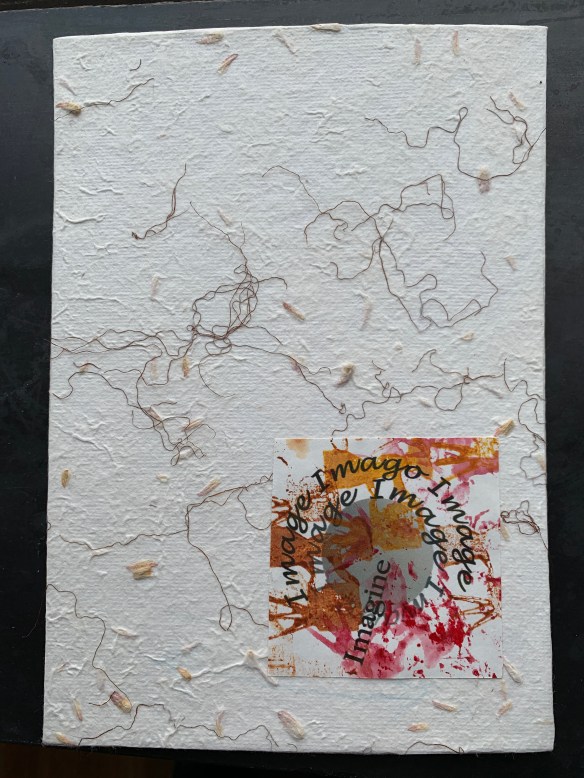
Once I figured all that out then I started putting it together. The paper is two sheets, 22 inches long, glued together. Boards for the covers have a handmade paper glued to them. The inside cover has a quote about the male gaze from Margaret Atwood. Inside back cover has a statement about female objectification. And there’s lots of cutting and glueing.
IMG_0064

In the meantime it’s occurred to me that when I get to book number 100 it will be a compilation of all of these blog posts.

And Another Two

I’ve been busy. I usually work on two or more books at any time. Frequently I will need more information or another image or just waiting for glue to dry. So this isn’t unusual. I was in Washington, D. C. in Spring and took pictures at the Burning Man exhibit at the Renwick.

IMG_4459

This huge sculpture of a woman dancing in freedom was the highlight for me. I took many pictures and I liked this explanation about the sculpture.

IMG_4461

I wanted to use the photos in a book but they weren’t wonderful. So the problem was how to express the same theme using my not wonderful photos. I looked online for an interesting binding (always a good way to add involvement) and found something that really worked for me.

IMG_0053 (1)

IMG_0061

I added ‘equal’ to the statement because women will never be safe unless they are equal. The book is small: 2 3/4″ by 5 1/4″ and opens to about 13 inches. It’s kind of an origami fold or modified Turkish map fold that begins with a square. The whole thing works best with relatively thin sheets of paper. My paper was 20″ wide; I wanted to make four squares, so each had to be five inches. The translucent vellum was really too thick but I couldn’t get thinner stuff through the printer. After much gnashing of teeth and three iterations I got what I wanted.

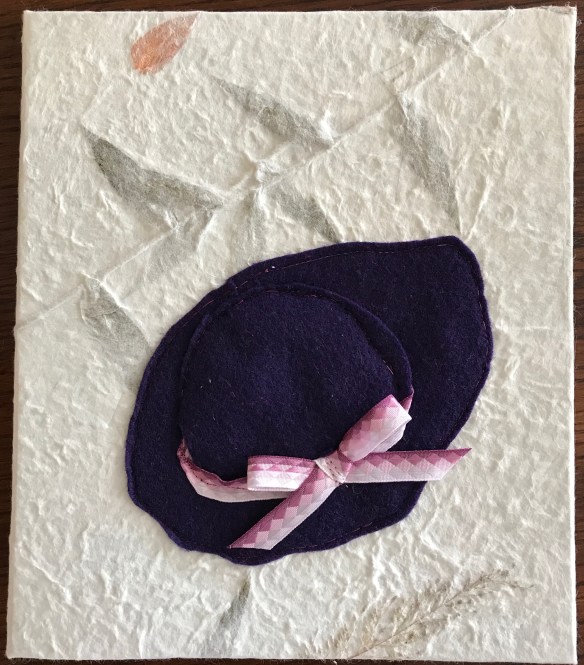
I began the second book before I started any of the other three. This is my redesign of Aunt Flo’s Memoir published as a page on this website. I could have printed out the pdf and bound it as a single page stab binding but I haven’t been happy with that binding. I went from 8 1/2 x 11″ single pages to 8 1/2 x 14″ folded pages creating four signatures of five folded sheets, twenty pages in each signature. It’s hard to figure out how many sheets you will end up with when images are involved and you should have an even multiple. Very tricky. I think it was more work that when I originally entered the material from the handwritten copy. After I printed it out to my satisfaction I spent a lot of time on a cover. Fancy paper by itself doesn’t do it for me. My aunt spent much of her life as a milliner, so I created a purple felt hat and stitched in onto a handmade paper with some plant inclusions.

IMG_0057 (1)


Two more books

IMG_0060

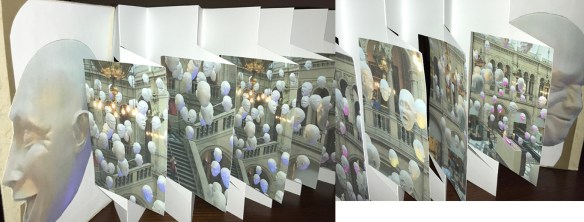
When I returned from the workshop in Scotland last year I made this book using photos of an installation by Sophie Cave in the Kelvingrove Museum in Glasgow. Structure of the book is based on a design created, I believe, by Hedi Kyle and known as a panel book. It is a simple accordion with a panel cut in each page so images rotate forward as the book is opened.

heads full

Covers are a light mat board with possibly handmade paper with botanic inclusions and a side strip of tan paper. Accordion is made of eight pieces of 100# Accent Opaque cover tabbed together. For the inside cover I enlarged two of the heads. Book is 8 5/8″ by 5 5/8″ and opens to 44 inches.

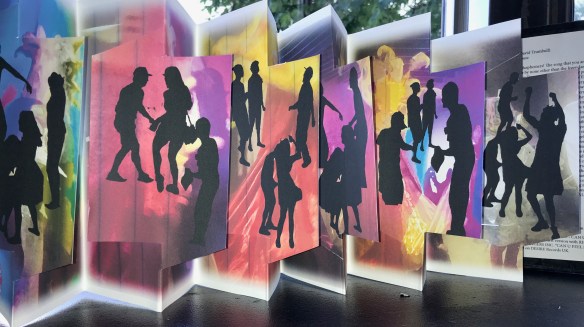
My book-making group liked this so much they asked me to teach it. This time I wanted an image over the entire page with the interest popping on the panel. I had some colorful, but unfocused images I shot of the puppet parade at First Night and used them for the background. Serendipitously, Eli took us to a House (music) festival at Millennium Park as I was thinking about this project. I took photos of people dancing, cut them out of their backgrounds in Photoshop, made silhouettes and put them on the panels, creating my House book.

img_0047-1.jpg

Although the book is simple there are many opportunities for errors, and I made all of them. So the letters on the cover were cut from pages I printed and couldn’t use. Then they were machine stitched to handmade paper I picked up years ago in the Himalayan store, possibly from Nepal. This time I used a thin book board that remained flat where the mat board curled.

IMG_0050 (1)

I wanted something on the back of each panel and found a poem about House music online. Additionally I added the entire poem on the inside of the front cover and a discussion about the origin of the poem inside the back cover. The book is 9 inches high by six inches wide and opens to 40 inches. Two pieces of Stonehenge Student make up the accordion with only one tab needed.


No. 78 again

I had an entire post written and it disappeared when I published. I am not happy. I’m also seldom happy with my finished books. There is always something I forgot or should have done better. I decided to try this one again. Content is the same. I made two changes in the structure going from a finished size of 5×8 inches to 5×7. Using a 30-inch wide Stonehenge print paper I was able to make the accordion with only 3 tabs instead of the tabs on each folded spread. Binding paper remains the same, but the curl is made with gold thread instead of rattail.

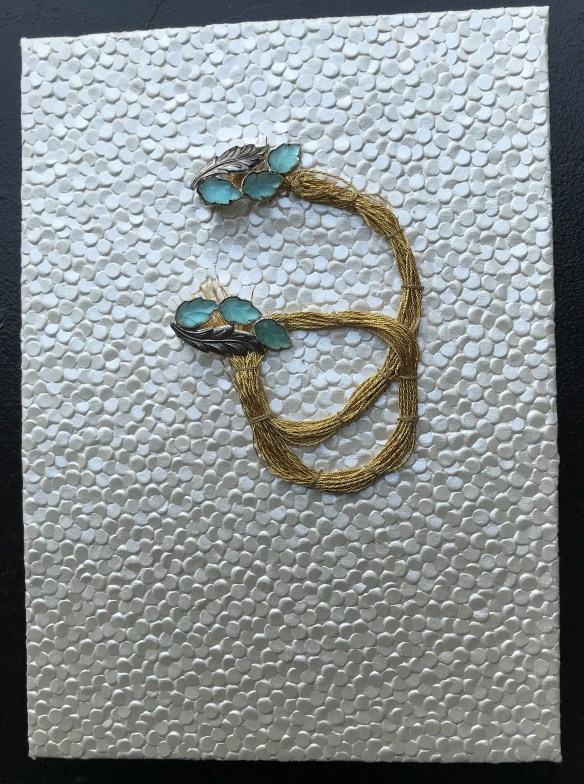
IMG_0037

IMG_0038The curl has been infinitely frustrating to me. Fitting, since frustrations with curls is the point of the book. But I wanted the curl on the cover to look like the one printed under Never Shirley.