I discovered this amazing bloom in my backyard. Again, no idea what it is.
The rhododendrum has these big fat buds.
This tiny flower is next to the front walk. It’s probably a weed and will disappear with the next gardener’s visit.
Author Archives: ruthek
Spring walk
I had a great urge to go out walking this weekend, but no one to go with. Finally decided to go over to the Frick Art and History Center to see a new exhibit: Steel, by Craig McPherson. Lovely work, but not enough walking. I continued on into the park. It was OK, Mary. Lots of people were there.
I like walking alone, even though Mary doesn’t want me to do it. I can stop and take pictures as often as I want, and I can maintain a lively internal dialog. Most of the time it was about what was going on in the park and looking for signs of spring. There were lots of early spring flowers in the neatly manicured part of the park, but it was much more difficult to see green in the natural part of the park. I could see evidence of more caretaking than is obvious when all the leaves have come out. 
A number of trees had been newly felled. They had either fallen on the trail or were menacing it.
The cut or fallen logs are left near the trail making fascinating designs on the fallen leaves. The cut surfaces are wonderful, also. 
You can see a little bit of green to the left of the tree stump.
I didn’t see any spring flowers, but there was much more green as I got to the bottom of the hill.
One of the more unpleasant aspects of walking in spring is the clear view you get of this huge house that looms over the park. It’s big enough to be a hotel, but I’m told only two people live there. Pittsburgh obviously needs better zoning laws. 
It’s not as noticeable in summer. I tried to find more info about the place, but without some basic data I can’t find anything. Alice does your friend know anything about this one?
After I left the park I was startled to see this tree with tiny red flowers all over it. 
Again, my lack of horticultural knowledge comes to the fore. I have no idea what this is. I tried to get a closeup of the flower, but I didn’t focus properly. One of the drawbacks of an autofocus camera and being too blind to do it myself.
Here is the iron fence surrounding the area I live in. Supposedly, Heinz installed it as a wedding gift for his new bride. How would you feel about an iron fence as a wedding gift? 
This fence runs all along Penn Avenue. It’s actually the first time I’ve walked down the entire block. I usually just cross Penn Ave and go on to my own street. Too much traffic on Penn to make it a pleasant walk.
Circumnavigating the entire huge block is more than a half mile. The east west streets have this stone wall
along them, and my street has stone pillars. All of the stones look like they might have been there for a century, but I have no way to know what is original.
This wonderful bronze emblem is embedded in the sidewalk just as you enter my street. It may also be very old, proudly set into the cement by the paving company. 
When is a rock not a rock?
I’m planning a trip to San Francisco early in May and got some info from an SF visitors site. One of the ads, for an art gallery, said they had "Rock Photography." I couldn’t figure out what that was. Were they showing photos of rocks like this?
Or was it rocks like this?
As a former photographer I wasn’t aware of a rock photography genre. I finally Googled rock photography and found out it was photos like this! All depends on where you’re coming from, I guess.
A Good Day
Sometimes everything works well. I had my yearly appointment with my ophthalmologist this morning. Recently, he moved his office to a nearby suburb; not far, but not convenient by bus. I spent a lot of time worrying about how to get there and looking at bus schedules. If I drive, how do I get back with my eyes dilated? It takes several hours for my pupils to recover, all that great stuff. And I had a class I wanted to get to this afternoon.
I finally decided to drive. It was one of those nice, gray Pittsburgh mornings. I figured that with dark sunglasses I might be OK. I got to the appointment with no trouble, the doctor saw me promptly (a miracle), told me everything was good and did not need to dilate my eyes.
I drove home in time to have lunch and went to take the bus to my class. Then, really good, one of my neighbors drove by and gave me a ride.
This was my last Tuesday Japanese Art class. Next week I will give a presentation about contemporary representations of death at Hiroshima. In two weeks, I have to turn in my paper (same subject). I’ve begun writing, so it shouldn’t be too agonizing.
Where I live
One of the classes I am taking is called "Reading and Writing the Iron City." Following is the story I wrote for my first assignment.
Meade Place is special—this was the clear message I was getting from Earl, as he showed me the apartment. He told me about the quiet street: the neighbors, Mary the quilter across the street; Sari the artist next door. He made me feel I could belong here. I liked the apartment; it reminded me of my house in Chicago; the only place I left with tears and regret.
Earl didn’t tell me that Meade Place had a special history. Shortly after I moved in Mary came to welcome me and brought a packet of information about the neighborhood. It seems that Meade Place was once the driveway leading to the mansion of H. J. Heinz. A 1999 article from the Pittsburgh Post Gazette described the mansion, how it was built; the additions Heinz made to it; and the many things he collected. The mansion was torn down in the 1920’s; the land subdivided for small homes. Only the coach house and a small building that once housed H. J.’s collections remain, now reinvented as apartment buildings, along with a low stone wall and a decorative cast iron fence along Penn Avenue, the south boundary of the property.
The area is very much a middle class enclave clinging tightly to its civility on the edge of chaos. We prefer to think of it as North Point Breeze, although it’s hard to say where it ends and Homewood, once the home of Pittsburgh industrialists, Westinghouse, Carnegie and Frick, begins. On summer nights we occasionally hear shooting from Homewood. The Westinghouse property, about a block away, is now a huge, open field called Westinghouse Park, where I am not entirely comfortable walking.
Most of the homes are single family. The owners are largely professional: a librarian, a doctor, a social worker, a newspaper editor. The building I live in, and the one to the east are almost identical duplexes. Earl lived upstairs in my building until several months before I moved in. The other duplex, not owner occupied, was converted into three apartments, and was the source of considerable tension in the neighborhood when I first arrived. An unknown number of tenants lived on the first floor. They were noisy, left beer cans on other people’s lawns, left a car on the street for months with one wheel removed. Since they left the street has once again become a model of middle class serenity, at least on the surface. Two women live in the attic of the duplex. We say hello, but not much else. After Christmas, Mary found their picture in the PG, in an article about Christmas dinners supplied by the Salvation Army for people down on their luck. The article said our neighbors lived in Homewood. It all depends on your point of view.
Destruction and remembrance
I am writing about Hiroshima for my Japanese art class–not about the bombing, but about the memorials and how they relate to earlier rituals and representations of death. My memory of what I saw at Hiroshima has not diminished, and I feel that dealing with this arcane art history topic is a little like having that elephant in the room that no one wants to see. To make up for ignoring the main issue I have been reading Hiroshima in America, a book that recalls the history of our use of the bomb, the distortions we created in the aftermath of its use, and how it affects our current policy about nuclear weapons.
I was 14 years old when we bombed Hiroshima and Nagasaki. I don’t remember much about it; only a discussion I had with two of my older cousins. They knew little more than me, but all three of us were confused and ignorant (along with the whole country). It took years for the whole story to become known. Our leaders did not want to acknowledge the truth, did not want us to know we were not the "good" people we want to think we are. All reports about Hiroshima and Nagasaki were censored (by us) for years afterward. We lost the opportunity to hear the stories of the survivors and to decisively influence how the world thinks about nuclear arms. Instead of acknowledging what we created, we have become mired in the argument about whether the Japanese "deserved" the bomb, and it has enabled us to think about the bomb as just another weapon.
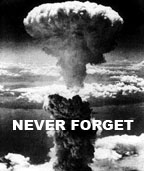
My visit to Hiroshima was a stunner. They’ve done an amazing job of conveying the horror and devastation; every world leader who thinks about nuclear weapons should be required to visit. We have forgotten our fear of the bomb, or we’ve become inured to it. This is something we should never forget.
Thanks to Charna, who diligently sends me news about climate change, species destruction and other things that upset her, I learned that our government has a plan to build more nuclear weapons–as if we don’t already have enough to destroy the entire world.
I took the following from the Union of Concerned Scientists website:
Despite the fact that the United States maintains hundreds of
nuclear-armed missiles on high alert, the administration still wants to
upgrade the entire U.S. nuclear weapons complex. This new
proposal–called "Complex Transformation"–would return the U.S. to a
Cold War cycle of designing, developing, and producing new nuclear
weapons. Fortunately, a mandatory environmental review allows you to
submit comments on this ill-advised draft plan. Please write
today–we don’t need the capacity to build NEW nuclear weapons; we need
to take the lead in moving closer to a world free of nuclear weapons.

Creative Pittsburgh
Addendum
Mary called me and we went out for a walk. It’s a beautiful, sunny day here in Pittsburgh but we’re expecting snow tonight and tomorrow. So much for spring.
I have to add one more torture to my catalog. I’ve written about this before. My tai chi class at the club, which is not really tai chi, but an hour of stretching and moderate exercise, requires full concentration on whether my right or left side is in motion. I’m facing the teacher; she has us all in a big circle with a candle (think spiritual) in the center. I’ve gotten better at it, but there are some movements I can’t follow; I always end up on the wrong foot.
Another exercise meditation
My Japanese art class has been studying depictions of the many Buddhist hells. (Number varies, depending on who you are reading and what you are talking about.) My own version of hell is exemplified by my fitness center. Of course, I should be there right now, instead of sitting here writing this. I’ve always thought about the weight machines as torture devices, watching some of the men groaning and sweating as they increase weight. Since I haven’t been getting there as often as I should, they torture me with just a minimum of weight. But they are not the only form of torture.
There is a large workout room across from the entrance to the women’s locker room. When class is in session the music is so loud I find it painful to walk past. I couldn’t take one of those classes; the loud sound would be more torturous than the exercise. That’s clearly Hell #1.
The locker room is not hellish, although it does have its moments. I wish I could take pictures in there. The woman who usually takes care of the room (cleans the toilets) is short, fat and always decorated with at least ten pounds of assorted rings, bracelets, earrings and necklaces. Her hair is different every time I see her; sometimes short and multicolored; other times covered with an elaborate wig. The variety of nude and semi-nude bodies is amazing. Being fat myself, I am especially fascinated with the really fat women. I am also fascinated with the occasional woman who will walk around nude completely unselfconscious. I couldn’t do that even when I was young and thin.
Which reminds me, there was an exhibit at the Pitt Union this week called the Century Project, a chronological series of portraits of nude women with statements from or about them. I spent a lot of time looking at the pictures, reading the statements and I still don’t know what I think about it. The idea, of course, is to make us understand what real women look like, as opposed to the airbrushed, or photoshopped, venuses we get in the media. It works, but I have a feeling it should have been better; I just don’t know what I would do different.
Back to hell in the health club: TV. They used to have 8 or 10 sets around the room. You listened with your own earphones, so there was no sound involved. I read when I’m on the bike, but I will watch when I’m on the treadmill. The sets had closed captioning, so I never bothered with the headphones. Now they’ve upgraded to individual sets on each machine, but no closed captioning. TV is torture, with or without audio. I spend most of my time on the bike.
The final torture is also something new: they’ve added a small cafe with salads, sandwiches and smoothies, advertised all over the place. Now you can expend all that energy while the think about food the whole time. I can’t think of anything worse.
Literary week
New Osher classes began this week. I’m taking one called Reading and Writing the Iron City. We did a fun exercise in class that may inspire me to do more writing. The instructor created a blog for the class, which you can visit here. BTW, the 250 in the blog name refers to this being the 250th anniversary of Pittsburgh’s founding as a city.
On Monday night, Robin and I went to a lecture by Scott Simon, the NPR Saturday morning anchor, who has written a novel about the Chicago city council. He said some of the reviews have called this satire, but he calls it political comedy; he says satire requires exaggeration. I loved the talk. He loves Chicago and so do I; very nostalgic. And, of course, I have to read the book. (After I finish writing my paper for the Japanese art class and read at least two other books: Hiroshima in America by Robert Jay Lifton and Gregg Mitchell, and David Halberstam’s last book, The Coldest Winter. My paper deals with Hiroshima, but the books are not reference material.)
Last night, Robin and I went to another talk, this time by Dave Eggers, of McSweeney’s, also with a book: What is the What, about Valentino, a Sudanese refugee. Although Eggers talked about the book and his visit to Sudan, most of his time was spent on the project dear to his heart, 826 Valencia, a writing center for children 6-18, now with spin-offs in seven cities around the country.
Have to stop now; it’s time to go to tai chi.