Back to school

This was the first week of my new Osher classes. I now belong to two Osher programs: Pitt and CMU. Most of my classes this time are at CMU. I'm taking tai chi with a different instructor; estate planning; Gulliver's Travels; a cooking class; Gigapan photography; and auditing another art history class at Pitt: Women in East Asian art. I volunteered (hah) to give a presentation on Tuesday at the art history class. Keeps me busy.

Originally I signed up for another class: Spanish conversation. I'd really like to learn Spanish. On the morning I was supposed to have the first class I overslept. I took this as a message from my body and dropped the class. Maybe next year. I may drop Gulliver, also. All we seem to be doing is reading aloud to each other. I'll see how the second class goes, but I'd really like something more than that.

Estate planning is good. Not that I have much of an estate, but I found out there are some laws here in Pennsylvania I ought to pay attention to.  Gigapan photography is really special. Did you see the amazing picture of the inaugural that you can zoom in on and see peoples faces and all kinds of detail? A robotic device takes pictures on a grid and stitches them together. We'll get an opportunity to borrow the robot and take our own pictures. Should be great fun.
Falcons and Skunk Cabbage

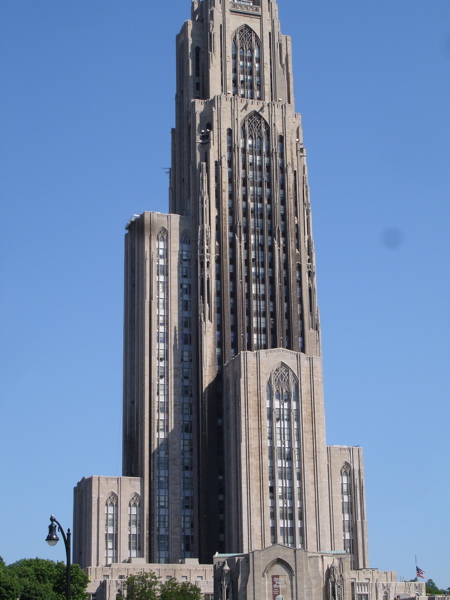
This week is spring break, but I’ve had wonderful OLLI provided experiences, all having to do with that additional level of awareness Alice mentions in her comment to the last post. After the geology walk on Wednesday, there was a class about the peregrine falcons that call Pittsburgh home. There are nesting boxes on the Gulf Tower downtown and the Cathedral of Learning at the University of Pittsburgh,Cathedral_before_cleaning_was_fin_2
both evidently look like cliffs to the falcons. You can see a webcam and learn about the Gulf Tower pair here. There is one egg in the nest already. That website from Pittsburgh’s National Aviary has links to the Cathedral of Learning webcam and to a bird blog written by Kate St. John, who was one of the presenters at our class. Our other presenter was Dr. Tony Bledsoe of the Biological Sciences Dept. at Pitt, who did a great job giving us all the facts about falcons.

Yesterday we went on a bus trip to the Powdermill Nature Reserve, the biological research station of Carnegie Museum of Natural History. You have to understand: I am very much a city person. I haven’t had a lot of contact with "nature," and I approach each event with a mixture of curiosity, awe and fear. I wasn’t sure what I was going to see at this time of year, possibly more mud, but I figured I had nothing to lose.

We spent the morning learning about the sustainable facilities development project and the Marsh Machine, their waste water treatment greenhouse. Powdermill Run is one of only a few streams in Pennsylvania considered excellent quality, never having been polluted by mine drainage. Here is an excellent article from the Post Gazette about the new facility, which, incidentally, uses carpeting made from recycled plastic bottles, counter tops made from compressed paper, flooring tiles from recycled tires.

After lunch, we took advantage of the beautiful spring day and walked on some of the trails at the reserve. I got my first good look at skunk cabbage,

Dsc06784

loved the little ferns just beginning to grow,

Dsc06793

and marveled at the rushing stream filled now with rainwater and melted snow. (Our guide, Theresa, is speaking with one of the members of our group.

Dsc06801

My friends in Chicago used to tease me–I was never lost in the city, but take me out where there are no street signs and I’m immediately lost. I need a lot of help learning to see in the natural environment.


Very satisfying day

This is Spring Break, but my geology class met today for a geology walk in Frick Park. It was a little gray and cold, and a lot muddy, but a great experience. This is the park I walk through fairly often. Today was completely different. I always look at the trees, the birds, the flowers. I’ve noticed the rocks, but never given them much thought. So, it was almost magical when Al Kollar, Dsc06757
from the Carnegie Museum of Natural History, showed us the evidence of how this area was under water, at least twice, and how the sandstone eroded to create the hollows and ravines in the park.

I was amazed to learn that the stones in the path were formed somewhere else two million years ago and deposited by the water. Dsc06762
Huge boulders I had walked past many times had fossils from sea water creatures. Still hard to see, but who knew! Alongside the path there was a fast moving stream–never there in summer or fall. It was almost like I was in a different park. Here’s an island beginning to form from the sediment in the stream.Dsc06759

There was lots of mud. Dsc06772
You can see all the traffic: bikes, dogs and people. The red mud is from the Pittsburgh red beds. Everything has a name.


Here are my muddy shoes. I haven’t had so much mud on my shoes since I was a kid.

Dsc06771